
6 Common Ankle Injuries in Football (And What to Do About Them)

Football is a fast, physical sport that demands a lot from the feet and ankles. Sprinting, sudden changes of direction, jumping, tackling, and landing on uneven ground all place the ankle under high loads. It’s no surprise that ankle injuries are among the most common problems seen in both amateur and professional players.
While some injuries are minor and settle with good early care, others can lead to persistent pain, instability, or recurring issues if they’re not properly diagnosed and rehabilitated. Below are six of the most frequent ankle (and related foot) injuries in football, what causes them, the typical symptoms, and how they’re managed.
1) Lateral Ligament Injury (Ankle Sprain)
A lateral ligament injury is the classic “rolled ankle” and is the most common ankle injury in football. It usually happens when the foot turns inwards (inversion), often after a mistimed landing, a tackle, or stepping awkwardly. The injury can be more severe if the ankle is pointed downwards (plantarflexed) at the moment of impact.
Symptoms can include:
Pain on the outside of the ankle
Swelling and bruising
Difficulty walking or pushing off
A feeling of instability, especially on uneven ground
Sprains vary in severity from a mild stretch to a complete rupture of the ligament. Early assessment matters, especially if there is significant swelling, deformity, or inability to weight-bear.
Early management
If there’s any concern about a fracture, it’s important to seek medical advice promptly. For soft tissue injuries, initial care often includes rest, ice, compression, and elevation. Gentle movement and a structured rehabilitation programme should begin as soon as it’s safe to do so, as this supports healing and helps prevent stiffness.
One of the most important parts of recovery is proprioception training—balance-based exercises that retrain the ankle’s sense of position and stability. Poor proprioception is a key reason players suffer repeat sprains.
When to seek help
If the ankle feels unstable after rehabilitation, or sprains keep recurring, an assessment is recommended. Ongoing instability may mean the ligaments have healed in a lengthened position, leaving the joint looser than it should be and increasing strain on surrounding structures.
2) Osteochondral Lesions (Cartilage and Bone Injury)
Not all ankle pain after a sprain comes from the ligaments. Sometimes the cartilage lining the ankle joint is damaged when the joint surfaces impact during injury. This can start as a bone bruise, progress to cartilage softening, and sometimes lead to a small crack or defect. In some cases, a cyst forms in the bone beneath the cartilage, creating an osteochondral lesion. Occasionally, a loose fragment can develop inside the joint.
Common symptoms include:
Deep pain within the ankle joint
Swelling that persists after activity
Stiffness
Catching, locking, or a “giving way” sensation
These injuries can be difficult to diagnose without imaging. If symptoms persist after an ankle sprain, further investigation may be needed to confirm the diagnosis and assess the size and location of the lesion.
Management
Early treatment typically focuses on protecting the joint, reducing load, and settling inflammation. This may include a brace or walking boot, crutches, compression, elevation, and pain relief. In some cases, an injection may be considered to help reduce symptoms.
If pain and mechanical symptoms continue despite conservative care, surgical treatment may be discussed. Smaller lesions may be treated arthroscopically (keyhole surgery) to stimulate healing, while larger defects sometimes require more complex procedures to restore the damaged area.
3) Ankle Impingement (Soft Tissue or Bony)
Ankle impingement occurs when soft tissue or bone gets trapped and pinched during movement, most commonly at the front of the ankle. This can develop after repeated sprains or ongoing microtrauma from football activity.
Soft tissue impingement
Soft tissue impingement often affects the front and outer part of the ankle. It may involve inflamed tissue that becomes thickened and painful over time.
Typical symptoms:
Pain at the front of the ankle
Swelling after training or matches
Reduced ankle dorsiflexion (difficulty bringing the foot upwards)
Physiotherapy, massage, and managing flare-ups with rest and swelling control can help. If symptoms persist, further treatment may be required.
Bony impingement
Bony impingement is caused by bone spurs (osteophytes), often at the front and inner aspect of the ankle. These can create a mechanical block that restricts movement.
Because bone spurs physically limit motion, conservative treatment may be less effective than with soft tissue impingement. Persistent symptoms may require specialist assessment to discuss surgical options.
4) Plantar Fasciitis
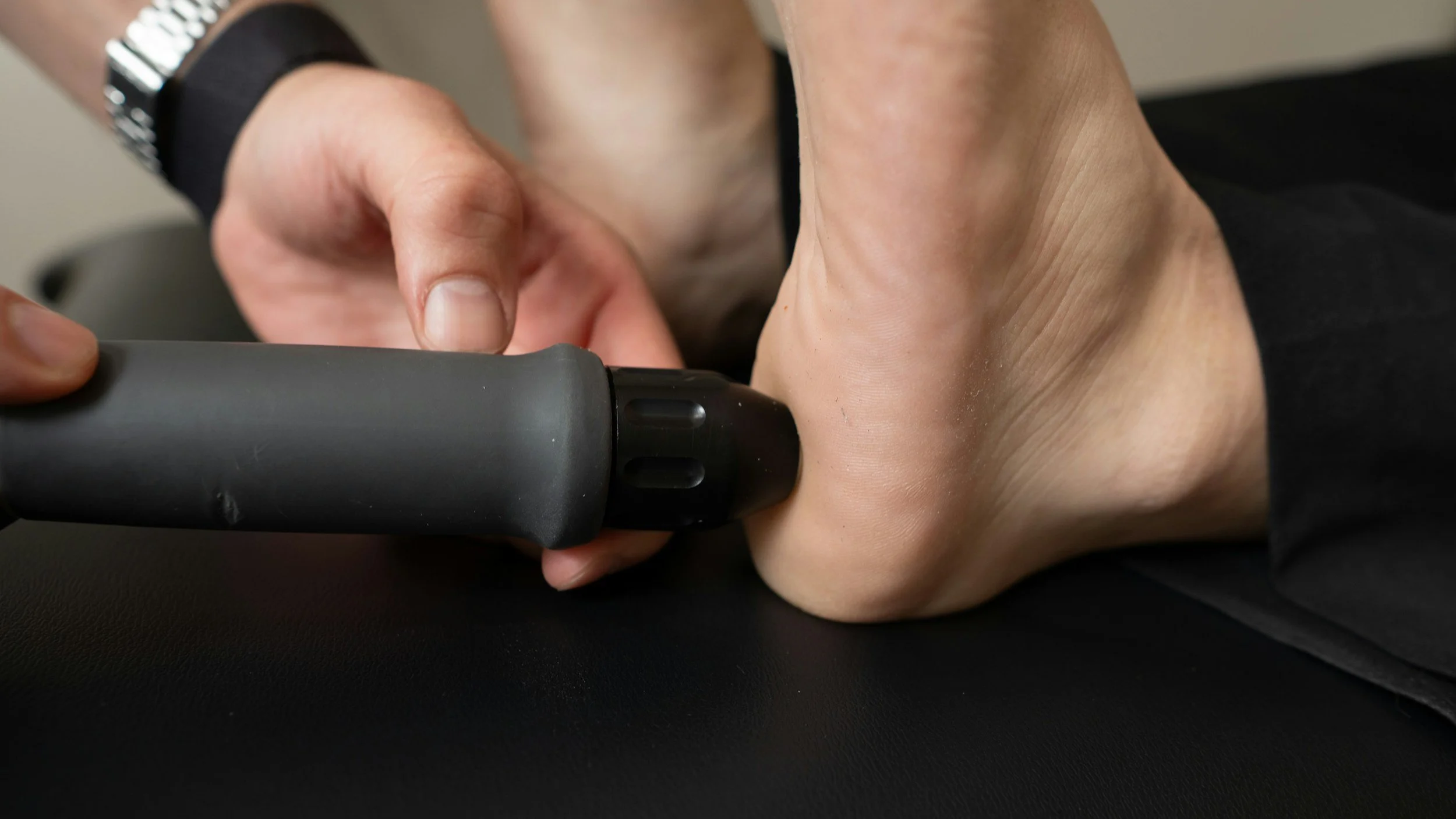
Although not strictly an ankle injury, plantar fasciitis is very common in football and often causes pain that affects training and performance. It involves irritation of the plantar fascia a thick band of tissue supporting the arch of the foot.
High training loads, sudden increases in activity, and playing on hard or artificial surfaces can increase risk.
Symptoms include:
Heel pain, often worst first thing in the morning
Pain after long periods of standing or training
Tenderness under the heel
Management
Most players improve with load management, a structured stretching programme (especially plantar fascia-specific stretches), and supportive footwear or orthotics. Some cases benefit from additional treatments such as shockwave treatment or a injection.
Prevention
A consistent warm-up and daily stretching routine especially for the calves and foot can reduce strain on the plantar fascia and lower the risk of recurrence.
5) Achilles Tendinopathy

Achilles tendinopathy is an overuse injury that can affect players at any level. It may occur in the middle portion of the tendon (mid-substance) or where the tendon inserts into the heel bone (insertional).
Repeated sprinting, jumping, and sudden increases in training load can irritate the tendon. In some cases, the tendon can partially tear, and healing may result in thickening or scarring.
Symptoms often include:
Pain and stiffness, especially in the morning
Swelling or thickening along the tendon
Discomfort after activity
Pain when wearing certain footwear
Management
Initial care focuses on reducing aggravating activity, improving calf flexibility, adjusting footwear (sometimes with heel lifts), and starting physiotherapy early. A gradual return-to-play plan is essential rushing back too soon increases the risk of worsening symptoms or rupture.
Persistent cases may require additional interventions and specialist review, particularly if pain is ongoing despite a well-structured rehabilitation programme.
6) Fractures (Ankle and Metatarsals)
Fractures in football can occur due to high-energy tackles, awkward landings, or collisions. Ankle fractures are often more serious injuries and may require urgent assessment, especially if there is visible deformity or inability to weight-bear.
Metatarsal fractures (bones in the forefoot) are also common in football. Modern boots can offer less protection, and these fractures may occur from direct impact or as stress fractures when training load increases suddenly.
Signs that should prompt urgent medical assessment include:
Severe pain
Significant swelling
Deformity
Inability to walk or put weight through the foot
Pain that worsens rather than improves over time
Some fractures can be managed in a boot or cast, while others may require surgical fixation depending on the bone involved and the degree of displacement.
Final Thoughts: Reducing Your Risk of Ankle Injuries
Football injuries can’t always be prevented, but the risk of ankle problems can be reduced with:
A proper warm-up before training and matches
Calf and ankle mobility work
Strength and balance training (especially proprioception drills)
Gradual increases in training load
Not returning to play until you’ve regained strength, control, and confidence
If you’re dealing with ongoing ankle pain, repeated sprains, or instability, it’s worth getting assessed. Early diagnosis and a targeted rehab plan can make the difference between a short setback and a long-term problem.
If you are a footballer and have a foot or ankle injury visit our clinic for specialist advice, see https://www.birminghamchiropodist.co.uk/ and Football Podiatry Clinic
